New to flying?

Where to start

Learning to fly comes with a wall of acronyms before you've left the ground. This page is the plain-English map: what the licences are, which theory exams sit behind each one, and where your study should begin.
The big picture

One ladder, one exam set per level

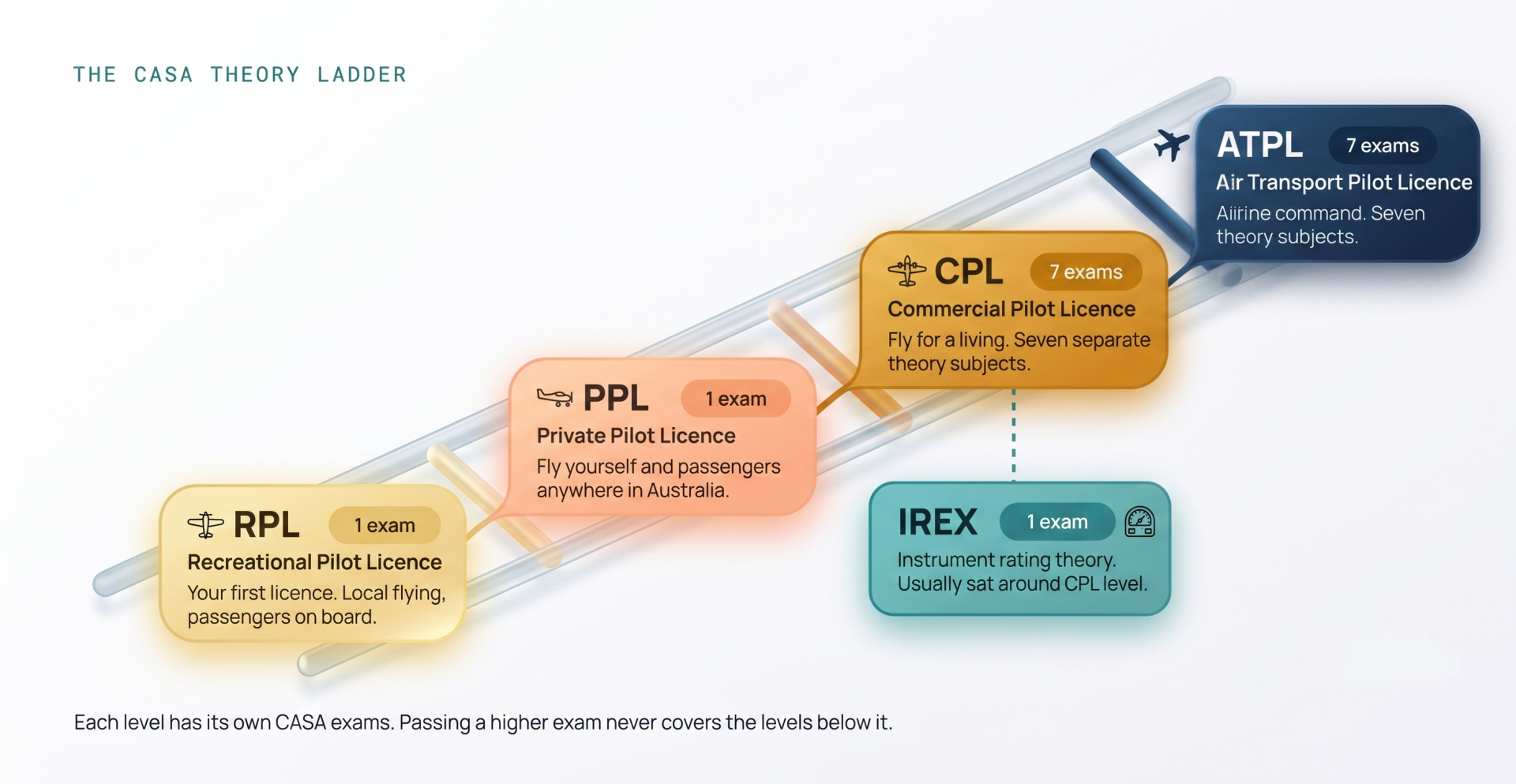
Every Australian pilot climbs the same ladder. The Recreational Pilot Licence (RPL) gets you flying light aircraft locally. The Private Pilot Licence (PPL) lets you fly yourself and your passengers anywhere in Australia. The Commercial Pilot Licence (CPL) lets you fly for a living, and the Air Transport Pilot Licence (ATPL) is the licence airlines expect for command of larger multi-crew aircraft. Alongside the ladder sits the instrument rating, with its own theory exam called the IREX, which unlocks flying in cloud and low visibility.

Here's the part that surprises most newcomers: each level has its own CASA theory exams, and passing a higher exam never covers the levels below it. The RPLA and PPLA are one exam each. The CPL and ATPL are seven separate subject exams each. That's why there's no single package that covers everything: you buy and study for the stage you're actually at.
Write your awesome label here.
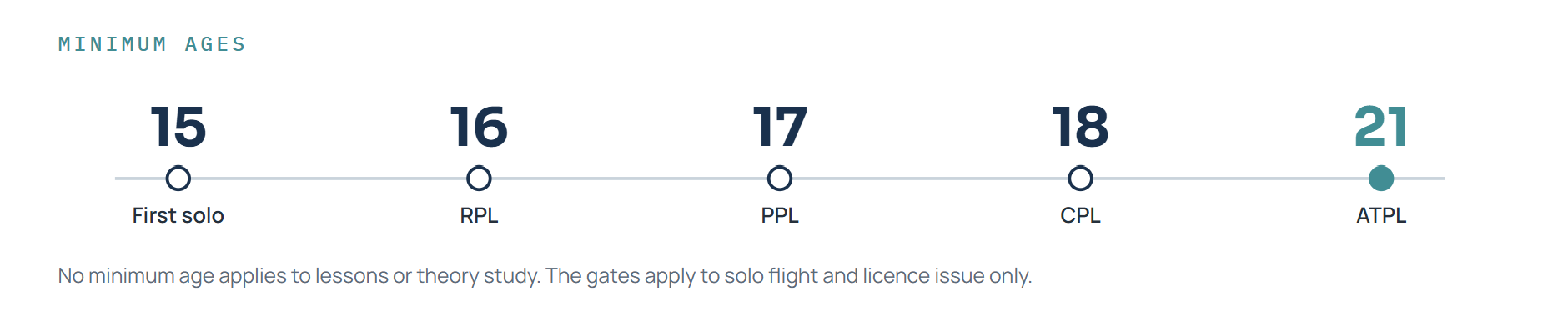
A few age gates apply along the way, but none of them stop you studying. There's no minimum age to start flying lessons or theory, and plenty of students pass exams before they're old enough to hold the licence itself.
Before you spend a dollar

Four checks that protect your training budget

Flight training is a five-to-six-figure investment by the time you reach a commercial licence, and a handful of boring administrative gates sit underneath all of it. Clearing them early costs an afternoon. Discovering a problem two years in costs a great deal more.
  • The medical. You need to pass a medical examination before you fly solo, and you'll hold a medical certificate for the rest of your career. Examinations are done by CASA-approved doctors called Designated Aviation Medical Examiners (DAMEs). A Class 2 certificate covers most training and non-passenger commercial flying, but airline-bound pilots eventually need a Class 1, which adds tests like an ECG and specialist eye examination. If you have any medical history you're unsure about, talk to a DAME before you commit serious money. It's the single most important early conversation in a flying career.

  • English language proficiency. Aviation runs on radio, and CASA requires every licence holder to meet an Aviation English Language Proficiency standard, assessed across pronunciation, structure, vocabulary, fluency, comprehension and interactions. A minimum of level 4 is required for an operational licence. Native speakers clear this comfortably, but it's assessed, not assumed.

  • The security check. When you apply for a licence you'll need an aviation security status check, done by applying for an Aviation Security Identification Card (ASIC) through an issuing organisation listed on the Department of Home Affairs website. Your flight school will walk you through it.

  • Education. Here's a myth worth killing: CASA requires no formal educational qualifications to train for a pilot licence. A solid grip on maths and physics makes CPL and ATPL theory easier, and many airlines look for passes at high school certificate level in both, so check the requirements of the employers you're aiming at. But nobody's asking for a degree before you can fly.

Picking your school

Choosing a flight training organisation

All licence training happens through a flight training organisation authorised by CASA under Part 141 or Part 142 of the regulations, and there are around 400 of them across Australia, alongside TAFEs and universities offering aviation programs. The structural choice that matters most is between two course types. Non-integrated courses, run by Part 141 schools, let you train at your own pace over any time frame, and suit people fitting flying around work. Integrated courses, run by Part 142 schools, are condensed full-time programs that combine ground theory with flight training, and they carry lower minimum experience requirements: 35 hours instead of 40 for a PPL, and 150 hours instead of 200 for a CPL in aeroplanes. Helicopter minimums differ again.

When you're comparing schools, look past the glossy fleet photos. Compare total cost including exam and flight test fees, the quality and availability of aircraft and instructors, and whether the course structure genuinely fits your timetable and budget. A school that mainly trains recreational and private pilots suits a different goal than one built around commercial pipelines, so match the school to the licence you actually want. Then book a trial instruction flight, usually around 30 minutes with an instructor, and treat it as a two-way interview. You're assessing them as much as the flying.

One more question worth asking any school: how is theory delivered, and when will you sit each exam? Some schools run classroom theory, some leave it entirely to you. Knowing which camp your school falls into tells you how much of the study load lands on your own routine.
The first fork in the road

RPL or PPL: which do you study first?

This is the question we're asked most by brand-new students, so let's kill the biggest myth straight away: the RPL is not a prerequisite for the PPL. Plenty of pilots never hold an RPL at all. Whether you sit the RPLA exam on the way through, or go straight to the PPLA, comes down to the training pathway you and your flight school choose.

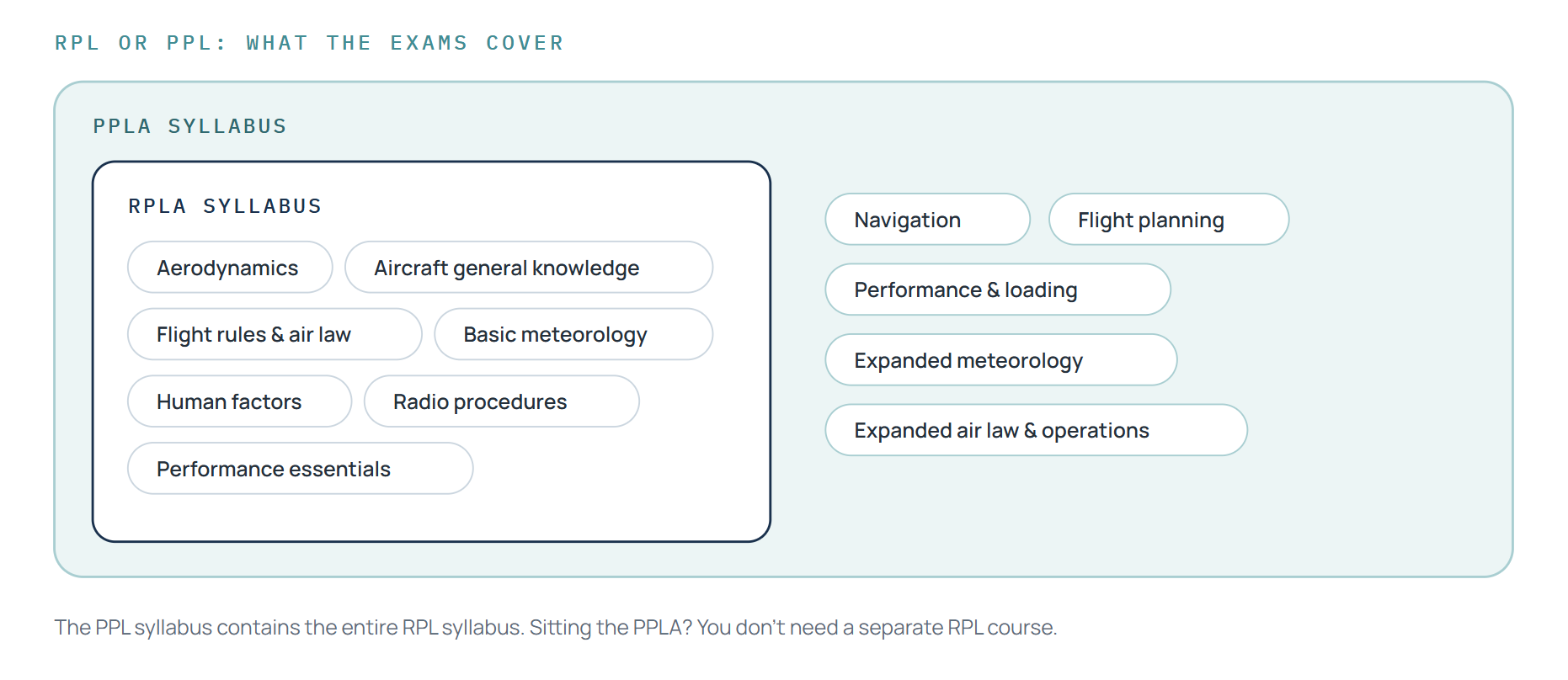
Here's why that works. The PPL theory syllabus contains the entire RPL syllabus, then builds on it with navigation, flight planning, performance and loading, and deeper meteorology and air law. Study for the PPLA and you have, by definition, covered everything the RPLA examines.

The licences themselves are genuinely different, though. An RPL lets you fly light single-engine aircraft (up to 1,500 kg) by day under the visual flight rules, carrying passengers, within 25 nautical miles of your departure aerodrome or your training area. It's a real licence and a real milestone, typically reached after your first 10 to 15 hours of instruction and your first solo. A PPL removes the leash: fly yourself and your passengers anywhere in Australia, in a much wider range of aircraft, and legally share the operating costs with the friends in the back. What neither licence allows is flying for payment. That's what the CPL is for.

What that means for your wallet: if your school has you sitting the RPLA first, start with the RPL course. If you're heading straight for the PPLA, go directly to the PPL course. You never need both.
The long game

What it actually takes to reach the airlines
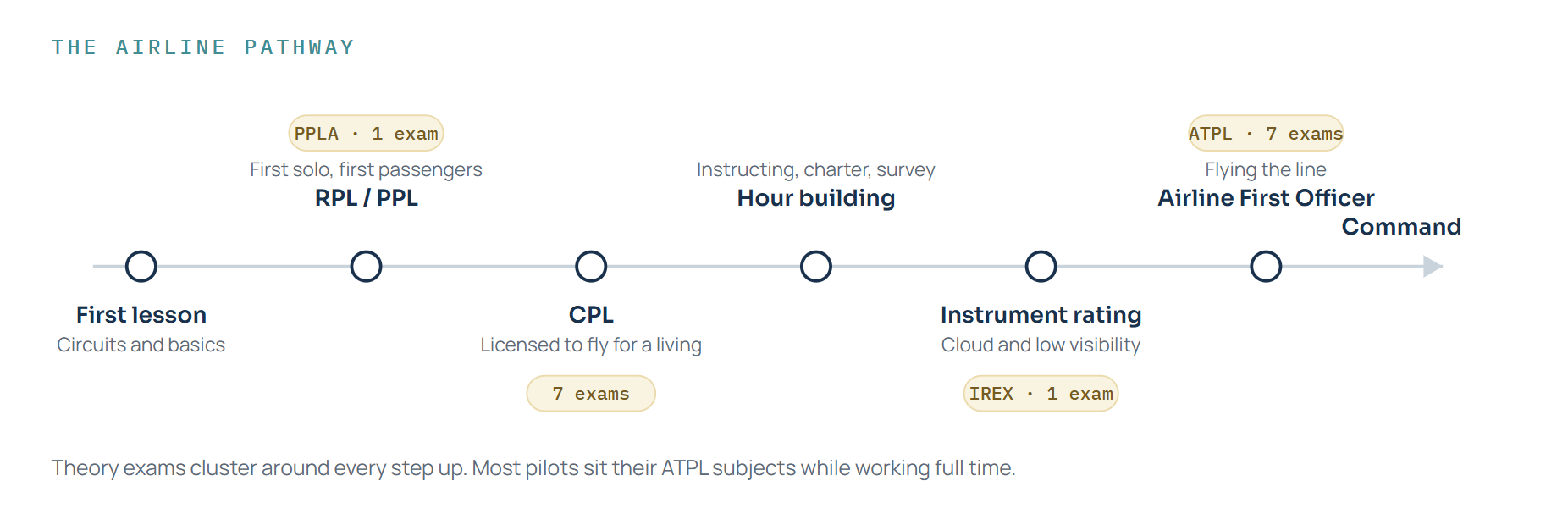
Every airline pilot you've ever flown with started in a light aircraft doing circuits. From there, the road runs through a commercial licence, a stretch of hour building in jobs like instructing, charter or survey flying, an instrument rating, and eventually an airline seat. The flying changes at every stage. The constant is theory.
  A typical airline pathway: around 16 CASA theory exams.
Count them up: the PPLA, seven CPL subjects, the IREX, and seven ATPL subjects. Add the RPLA if you start there. The experience requirements climb alongside the exams: a CPL in aeroplanes needs 150 to 200 hours depending on your course type, and an ATPL needs 1,500 hours plus a multi-crew cooperation course, which is why most pilots sit the ATPL exams while they're hour building or already flying the line. That's exactly when desk time is hardest to find, and exactly why we built these courses as audio.

One honest note about the destination: aviation hiring moves in cycles. Airlines recruit in waves, pause for years, then surge again. You can't control the cycle, but you can control whether your theory is finished when the doors open. Pilots with exams already passed move first when recruitment restarts.
Habits over heroics

Study habits that survive a flying career

Here's something flight schools rarely say out loud: the studying never stops. Pass every exam on this page and you'll still be studying for the rest of your career. Proficiency checks come around every six to twelve months. Airline pilots cycle through recurrent ground school year after year. A new type rating arrives with weeks of systems, limitations and memory items to learn. Legislation changes underneath you whether you're watching or not, and a whole generation of pilots who qualified under the old rules had to relearn their framework when Part 61 arrived. Your theory exams are the entry fee. The study habit is the career skill.

CASA quietly reinforces this. When you sit a theory exam, your result comes with a Knowledge Deficiency Report listing the syllabus areas you got wrong, and your flight test examiner is required to probe those areas in person. Weaknesses follow you until you close them, so the habit of finding and fixing gaps starts on day one.

So build habits that scale beyond one exam. Little and often beats cramming, every time. Twenty to thirty minutes a day for a month carries you further than two desperate weekends, because each short session interrupts the forgetting before it takes hold. Anchor study to routines you already have, so the theory happens while you commute, exercise, walk the dog, or do anything else that leaves your ears free. A habit tied to an existing routine survives roster chaos; a habit that needs a free evening doesn't.

Test yourself relentlessly. Reading or listening again feels productive, but retrieval is what builds recall you can use under pressure. Work practice questions early and often, and treat every wrong answer as your own private Knowledge Deficiency Report: go back to that topic, close it, retest it a few days later. Mix your subjects rather than blocking a month on one topic, because rotating between meteorology one day and air law the next feels harder but holds better, and it mirrors how real exams jump between everything at once. Explain things out loud. If you can talk a mate, a voice memo or the dog through how a cold front behaves, you understand it. If you can't, you've found tomorrow's session.

Two final rules from the flight deck. Rehearse under match conditions: before the real exam, sit full-length practice papers timed, with only the materials the exam actually permits. And protect the machine: you already know fatigue wrecks flying performance, and it wrecks study just the same, so schedule sessions when you're fresh rather than bolting them onto the end of a long day and calling it discipline.
Your first purchase

Which course should you start with?

Match your next CASA exam to the course built for it. Every theory course below is a complete exam preparation system: audiobook theory, guided audio practice exams and randomised written practice exams, with 12 months of access.

Sitting the RPLA

Your school's pathway includes the RPL. Over 15 hours of audiobook theory for your first CASA exam. Get both the RPLA theory course plus the RPL(A) Flight Test Theory Guide bundled, together worth $98. 12 months of access from the date of purchase.

Going straight to the PPLA

Covers the full PPLA syllabus, which includes everything in the RPLA. No separate RPL course needed. Available as a bundle, the PPLA theory course (audiobook, guided audio practice exams and written practice exams) plus the PPL(A) Flight Test Theory Guide, together worth $146. 12 months of access from the date of purchase.

Starting your CPL subjects

Seven subjects, available individually or as the CPL Complete Preparation Bundle with the flight test guide included.

Adding an instrument rating

The complete IREX theory syllabus in around 6 hours of audio, plus practice exams.

Tackling the ATPL

All seven subjects individually, or the full seven-subject package. Built for pilots studying around a roster.

Flight Test Theory Preparation

Passed the theory and preparing for the flight test itself? Our Flight Test Theory Guides cover the ground component, the sit-down with the examiner, for the RPL(A), PPL(A), CPL(A) and Instrument Rating.
Still not sure where you fit?
Email support@pilotaudio.com.au and tell us where you're at in your training.
We'll point you at the right course, and nothing more than the right course.
Thank you!
Licensing requirements on this page are summarised from Civil Aviation Safety Authority guidance and were current at the time of writing. Requirements change, so always confirm the current rules with CASA (casa.gov.au) and your flight training organisation.
Created with